Samsung Shares Rally After Launch of Advanced AI Memory Chip Designed for Next-Generation Data Centers
The tech giant’s new HBM4E memory chips promise faster speeds, improved energy efficiency, and larger capacities as Samsung intensifies its battle for dominance in the booming AI semiconductor market.
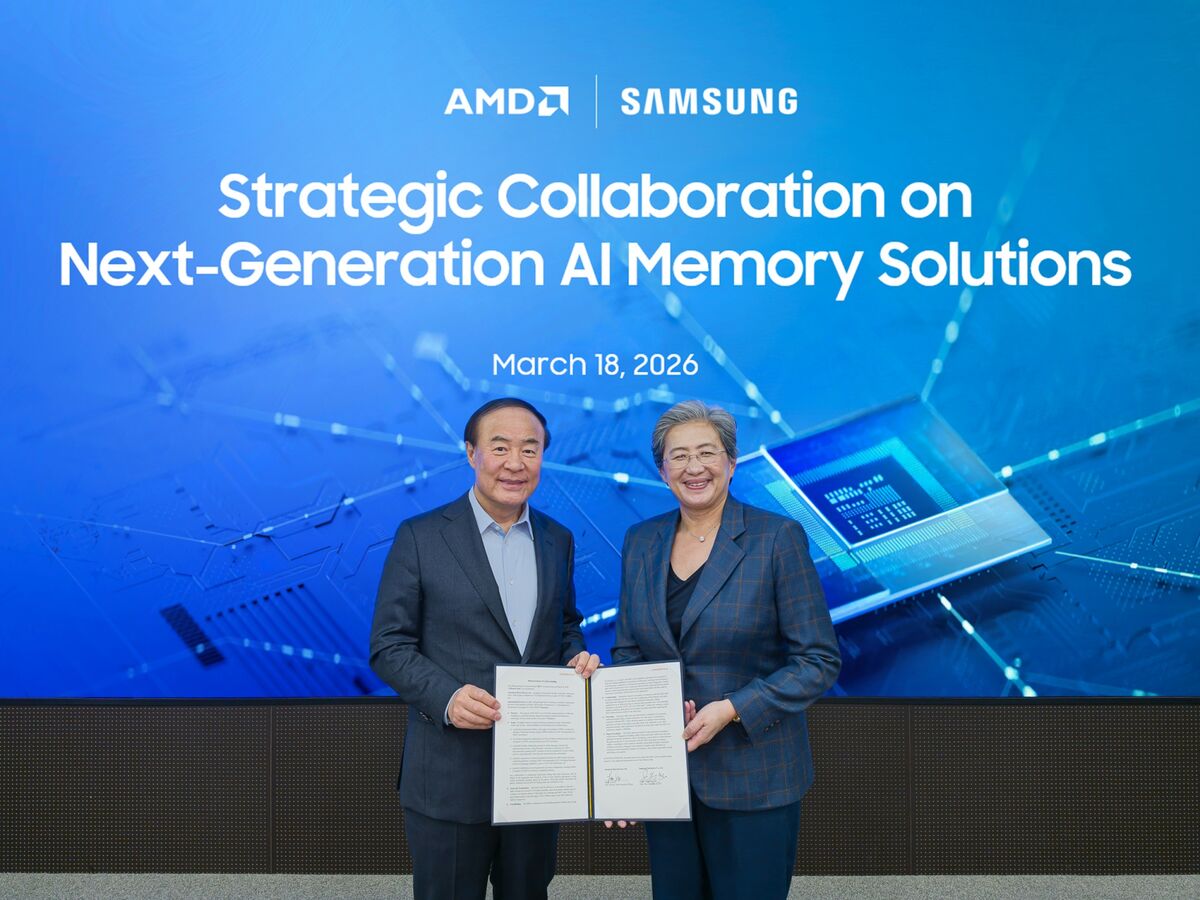
Photo: Bloomberg.com
Shares of Samsung Electronics surged more than 6% after the company announced it had begun shipping samples of its latest high-bandwidth memory chip to global customers, marking a major step in its effort to strengthen its position in the rapidly expanding artificial intelligence semiconductor industry.
The announcement boosted investor confidence as the global race for AI infrastructure intensifies, with demand for advanced memory chips continuing to accelerate alongside the explosive growth of generative AI systems, cloud computing, and high-performance data centers.
Samsung’s latest product, the 12-layer HBM4E memory chip, is being positioned as one of the company’s most advanced AI memory solutions to date.
The South Korean chipmaker says the new chip delivers higher bandwidth, better thermal efficiency, and improved performance compared to earlier generations, making it particularly suited for next-generation AI accelerators and large-scale machine learning workloads.
Samsung Pushes Deeper Into the AI Memory Battle
High-bandwidth memory, commonly known as HBM, has become one of the most important technologies powering the artificial intelligence boom.
Unlike traditional memory chips, HBM stacks multiple layers of Dynamic Random-Access Memory vertically, allowing significantly faster data transfer speeds while reducing power consumption and saving physical space.
These capabilities are critical for modern AI systems, which require enormous bandwidth to process vast datasets efficiently.
Samsung’s new 12-layer HBM4E chip can reportedly achieve speeds of up to 16 gigabits per second while improving both energy efficiency and thermal management — two factors becoming increasingly important as AI data centers consume growing amounts of electricity.
The chip also delivers a 48-gigabyte capacity, representing more than a 30% increase compared to the previous generation of HBM products.
Samsung said it plans to expand the HBM4E lineup further with future versions including an 8-layer 32GB configuration and an even more powerful 16-layer 64GB variant depending on customer demand.
AI Infrastructure Demand Continues Exploding
The rapid growth of artificial intelligence has transformed advanced memory chips into one of the semiconductor industry’s most strategically important markets.
Modern AI accelerators rely heavily on HBM technology because traditional memory systems struggle to keep pace with the massive computing demands of large language models and advanced AI applications.
Companies such as Nvidia, Google, Microsoft, and other major cloud providers are investing billions of dollars into AI infrastructure requiring increasingly powerful memory solutions.
Samsung said its latest chips are designed to support advanced processors such as Nvidia’s Rubin AI platform and Google’s Ironwood Tensor Processing Units, both of which require enormous data throughput to operate efficiently.
Industry analysts expect demand for HBM chips to remain exceptionally strong over the next several years as AI adoption expands across industries including cloud computing, robotics, autonomous driving, healthcare, financial services, and enterprise software.
Some market forecasts predict the global HBM market could grow severalfold by the end of the decade as hyperscale AI data centers continue expanding worldwide.
Samsung Tries to Close the Gap With SK Hynix
The launch also highlights Samsung’s broader strategy to narrow the competitive gap with SK Hynix, which currently holds a strong position in the high-bandwidth memory sector.
SK Hynix has emerged as one of Nvidia’s primary HBM suppliers during the AI boom, helping the company gain significant momentum in the global semiconductor market.
Samsung has been aggressively accelerating development of next-generation memory products in response.
Earlier this year, Samsung began shipping samples of its HBM4 chips as part of a larger effort to strengthen relationships with AI chipmakers and hyperscale cloud customers.
The introduction of HBM4E represents another important step in that strategy.
The company is leveraging its large-scale manufacturing capabilities, semiconductor fabrication infrastructure, and advanced packaging technologies to compete more aggressively in premium AI memory markets.
Samsung executive Sang Joon Hwang said the company plans to continue expanding production capacity and investing heavily in future AI memory technologies to meet rapidly rising global demand.
Memory Chips Become the Heart of the AI Economy
The AI boom has fundamentally changed the semiconductor industry over the last two years.
While central processing units once dominated computing discussions, advanced memory systems are now becoming equally critical because AI workloads require enormous amounts of high-speed data movement between processors.
Without advanced HBM chips, many of today’s most powerful AI systems would struggle to function efficiently.
That has transformed companies specializing in AI memory into some of the most closely watched firms in global technology markets.
Competitors including Micron Technology are also racing to expand HBM production and secure long-term supply agreements with AI infrastructure providers.
At the same time, global demand for advanced semiconductor packaging, data center networking, and energy-efficient computing systems continues to surge alongside AI growth.
Investors Respond Positively to Samsung’s AI Strategy
Samsung’s stock rally reflects broader investor optimism surrounding companies directly tied to AI infrastructure development.
Technology investors are increasingly focusing on semiconductor firms capable of supplying the hardware required to train and deploy advanced AI models.
The memory chip market, once known for sharp pricing cycles and volatile earnings, is now benefiting from structurally stronger demand driven by artificial intelligence workloads.
Analysts believe premium AI memory products like HBM4E could help improve profitability for Samsung’s semiconductor division while strengthening its long-term competitive position.
The company has faced pressure in recent years from weaker consumer electronics demand and cyclical downturns in traditional memory markets, making the AI sector an especially important growth opportunity.
The Global Race for AI Semiconductor Leadership Intensifies
Samsung’s latest announcement underscores how aggressively global chipmakers are positioning themselves for the next phase of AI expansion.
The battle is no longer limited to processors alone. Memory performance, energy efficiency, packaging technology, and data movement capabilities are now equally important in determining which companies lead the future AI ecosystem.
As AI models grow larger and more computationally demanding, next-generation HBM solutions are expected to become essential components of nearly every major AI platform.
For Samsung, the launch of HBM4E is more than just a product update. It is part of a broader effort to reclaim technological leadership in one of the most strategically important segments of the global semiconductor industry.
With AI infrastructure spending projected to rise sharply over the coming years, the competition between Samsung, SK Hynix, Micron, and other chipmakers is likely to become even more intense.